
Carrying the Flame
Or what it means to transmit a craft knowledge like glassmaking

In 1923, when Whitefriars Glass moved from its home off Fleet Street to a new factory in Harrow, the glassmakers carried a burning brazier across the city. Not ceremonially–a live flame was taken from the old furnace, transported through the streets of London, and used to light the first fire at the new site.
The furnaces at Whitefriars had been making glass since 1680. The point was simple: the fire should not go out.
—
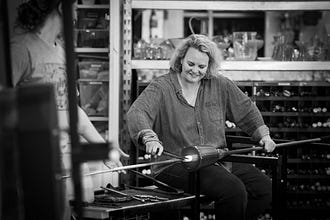
My friend and fellow glassmaker Michael Ruh wrote me an email after I published my last article on the state of British glassmaking. In it he pondered his own position in the lineage of glassmaking in the UK, and since I trained with him and his partner Natascha Wahl at their London studio very soon after first learning glassmaking, his email lit a curiosity in me about my own glassmaking lineage. In a family tree scenario of craft lineage, they feel like the closest thing to my parents.
Turns out there’s a somewhat official chronology of the studio glass movement. This lineage has been carefully documented by the Corning Museum of Glass—compiled by William Warmus, a curator, and Beth Hylen, a Rakow librarian, into something close to the field’s official record. It traces the studio glass movement through exhibitions, programs and named artists from 1962 to the present. Like all children of specific traditions, I find myself trying to understand my relationship to it.
Where did the hand skills I inherited come from?
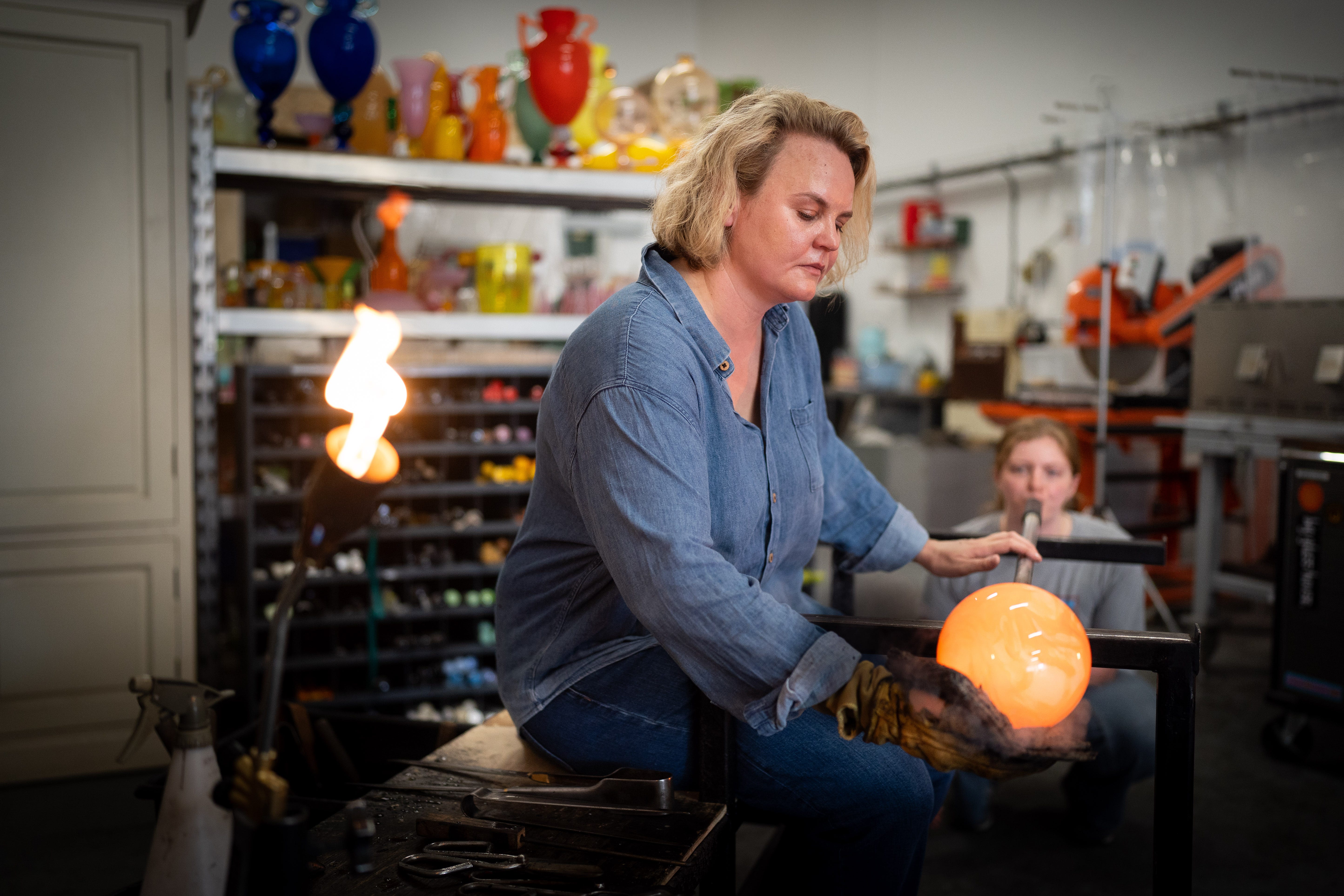
The Corning official record begins with Harvey Littleton, who in Toledo, Ohio, in the spring of 1962 rented a storage shed at the Toledo Museum of Art and set out to prove that glass could be blown by a single artist in a small studio, not only in factories with industrial equipment. From that shed, the American studio glass movement was born.
Within a decade there were fifty glass programs in universities across the United States. Littleton’s student Dale Chihuly went to RISD and then founded Pilchuck Glass School on a tree farm in Washington State. Chihuly’s student Richard Harned went to Ohio State. Harned’s student Chris Taylor returned to RISD as a teacher.


If it felt like the right thing to do, I could place myself after Chris Taylor on this tree. In 2009 he taught me when I audited his Advanced Glassmaking Techniques class at RISD. So there I am, four generations down in the Studio Glass Movement.
But it feels fundamentally wrong to me, and not exactly my natural home, for a few reasons.
First, craft knowledge does not move like a chronology. It seeps like weather.
Converging forces produce the particular day you happen to be standing in. Glassmaking is not knowledge that moves through diagrams of who taught whom. You cannot write down what a skilled gaffer knows and have someone else learn it by reading. The knowledge travels through proximity and absorption. It arrives the way tacit knowledge always arrives: laterally, strangely, through watching someone work with such intensity that the movements make sense in your own muscles. And through long hours of assisting someone do something tricky until your body begins to understand it too—first as sensation, and only later as thought. That knowledge has historically been received in a workplace, and over years rather than semesters.
I first tried glassmaking at a place called, at the time, the Liquid Glass Centre, now The Glass Hub, with glassmakers who had come through Bristol Blue—a studio grown from the dispersal of Whitefriars’ workforce when the factory closed in 1980.
From there I went to Bournemouth and Poole College, working under Rob Marshall, also from Bristol Blue, alongside Geoff Innell as technician, who had worked at Dartington—a Devon glassworks founded in 1967, originally staffed by master blowers brought from Kosta and Orrefors in Sweden. Little did I know that the Scandinavian stream was also already absorbed into the British one before I knew there were different streams.
Through Rob Marshall I met Michael Ruh and Natascha Wahl, who run Michael Ruh studio in London, where I first worked in a production setting, assisting Michael to make glass every day.
In Michael’s email to me, he describes his own glassmaking history. Michael was introduced to glass by Koen Vanderstukken and Miloslava Svobodova at IKA in Mechelen, Belgium, and came to glassmaking in London through LA Studios. Louise and Andrew Hay, who founded LA studios, gained their skills through The Glasshouse in Covent Garden, the first independent glass studio in the UK, founded in 1969 by Sam Herman. By that measure he’s technically another direct descendent of the American Studio Glass Movement.
But Michael’s lineage through LA Studios meant assisting people who learned from the likes of Annette Meech and Christopher Williams at Covent Garden, meaning back to Ronnie Wilkinson, the gaffer there (the name given to the lead glassmaker and skill holder in the production process). He was widely regarded as one of the most skilled glassblowers in Britain, and was initially from Whitefriars, a descendent of the crystal factory tradition. All the people who worked with Ronnie at The Glasshouse—Steven Newell, Simon Moore, Bob Crooks, James Watts, Catherine Hough and others—dispersed into their own studios, and Ronnie’s skills from Whitefriars disseminated with them.
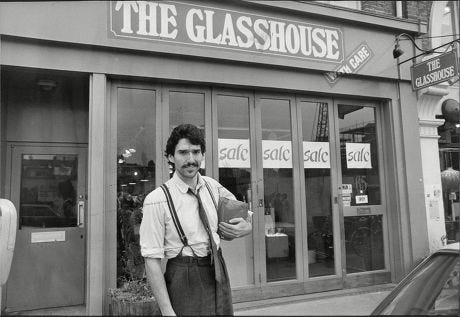
When Michael joined LA, British glass workshops ran on high street orders—Habitat, the Conran Shop, John Lewis, Heals, Selfridges. Making glass meant ‘production work’, the name glassmakers give to tableware, such as tumblers and jugs, the smaller pieces you might make many of in a day. It meant long production runs, the discipline of repetition, the knowledge that only comes from making the same thing hundreds of times until it becomes a reflex. Despite The Glasshouse being a descendent of the Studio Glass movement, it also had a deeper tradition running through it via the production skills of its lead gaffer.
Natascha Wahl trained in Germany at the Glasfachschule Hadamar. Michael originally came from the US. They met in Belgium. They came to London and built a studio from the ground up. Before and after my time there, working as an assistant and learning the fundamentals of how to be a glassmaker from them, they also trained glassmakers from Germany, Sweden, Austria, Lithuania, Ireland, Japan, Hong Kong, the United States and London. I feel intensely lucky to have had that training.
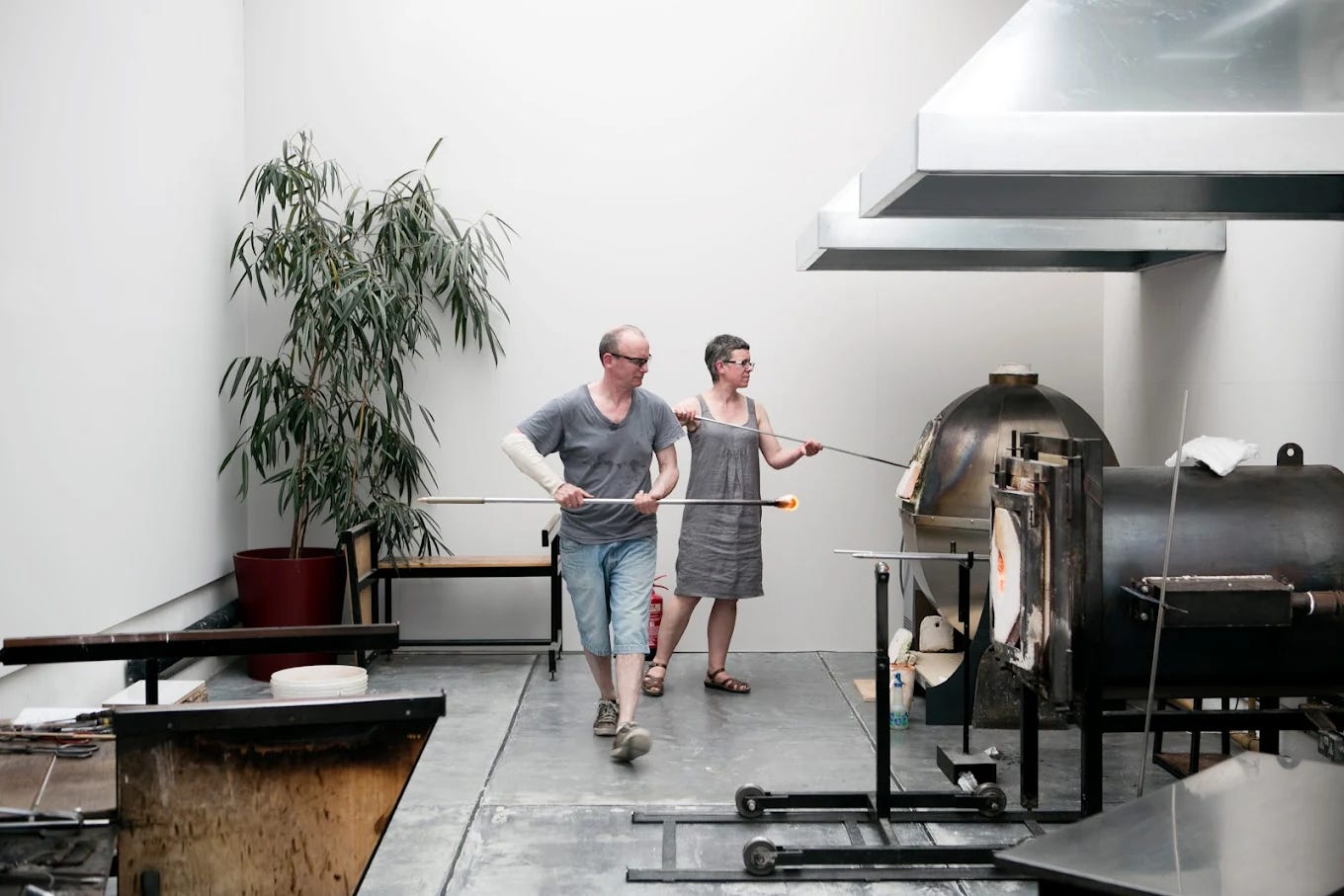
What they built functions on a principle that is almost invisible if you are looking only at official histories of Studio Glass. But it is in studios like theirs, making beautiful handmade glass for tables across the world, that glass knowledge multiplies and disseminates.
To assist someone in a hot glass studio is to be in contact with a person’s skills in a very particular way. The furnace is intense. The heat is total. The attention required is absolute. You learn actively, not by passive instruction, but by absorption: intensely watching how their body behaves around the material—the way they turn the iron, the moment they choose to reheat, the half-second before they decide what tool to use.
You absorb a way of moving. And inside the way of moving is a way of thinking. And deep inside that is a set of values about what making is for.
Glassmaking’s gift is an active awareness, a transmission granted through heightened observation and laborious doing.
None of this appears in an official chronology. But it is the mechanism by which craft knowledge actually survives.
I think of Michael and Natascha’s studio as my own personal watershed, because it opened up for me a world of glassmaking I would never have known about. Their partnership brought together an intense confluence of skills and influence, and it gave me options in the form of knowledge about traditions from different places.
Casual mentions of places I had never heard of turned into whole adventures in my life, and new communities of friends. Because of conversations with them, before graduate school, I was lucky enough to go to Pilchuck Glass School.
Pilchuck sits on a former tree farm in Washington State. It began in 1971 as a field with no electricity, no running water, eighteen students, and the ambition to change how the world thought about glass.


By the time I arrived it had become something stranger and more interesting: the place where every surviving tradition in contemporary glass briefly overlapped. American studio glass, centuries of Murano skills, Czech sculptural glass, Scandinavian functional glass, Japanese and Korean artists and many more—all of it meeting for a few weeks each summer in the same forest.
I took a class with Fritz Dreisbach, one of Littleton’s original students, teaching alongside Frantisek Janak from the Czech tradition—two first-generation makers from two lineages running in parallel, barely touching until Pilchuck put them in the same room.
It was there too that I watched Nancy Callan and Katherine Gray run a long demonstration—a large, exacting, blown piece, with every role in the hot shop occupied by women. At the time (2008 ish) I did not understand what was unusual about what I was seeing. I simply watched women doing the work I wanted to do, with complete authority, technical mastery and no explanation required.
A permission arrived that I had not known I needed.
Craft knowledge moves this way too. Not only techniques and instincts, but permission. That too travels without being announced, arriving in the body before the mind has words for it.
To understand how far back these transmissions go, you have to look beyond Toledo and the American studio movement. You have to go back to two towns in Italy, and a difference in attitude about transmission that has shaped the glass world for seven centuries.
In 1291, the Venetian Republic issued a decree relocating all its glassmakers to the island of Murano. This was mostly to reduce fire risk in the city. More honestly it was to control knowledge. The techniques that made Venetian glass the most prized in Europe—its clarity, its colour, its capacity to be drawn into forms no other material could hold—were to be kept on the island. Masters were forbidden to leave. Those who tried faced fines, imprisonment, and worse. For centuries, Murano held its secrets by holding its people captive.
Fifty miles away, in the mountain town of Altare in the Ligurian Alps, the glassmakers had arrived at the opposite conclusion. The Università d’Altare—their guild, active since at least the twelfth century—actively permitted dispersal. Its statutes allowed members to travel freely and establish furnaces wherever there was demand, in Italy or beyond. Where Venice built a cage, Altare built a diaspora. Altarese glassmakers appear in the historical records of France, Spain, the Netherlands, Portugal and England. One of them, Giobatta Da Costa, is often credited with developing the formula for flint glass in London in 1674, working in the Savoy glasshouse established by George Ravenscroft—the merchant whose name history gave to the invention of English lead crystal, though the knowledge in the furnace likely came from Altare.
The London glass trade was founded on this Altarese model. Jean Carré, a merchant from Artois with Venetian connections, arrived in England in 1567 and obtained a royal patent from Elizabeth I, on the explicit condition that he teach his methods to English apprentices. The knowledge that would become the English crystal tradition, that would become Whitefriars, that would become the gaffers who trained the people who trained me, entered this country in the bodies of people who were, by the terms of their patents, required to teach what they knew.
These two towns represent two ancient arguments about craft knowledge. Hold it. Or share it. The glass traditions I come from were built on the Altare answer.
Trace my lineage through Michael and Natascha’s studio backwards and you eventually arrive at Whitefriars. Trace Whitefriars and you arrive at the Italian craftsmen who crossed the Alps in the sixteenth century carrying technique in their hands.
Which brings me back to the brazier.
—
When the glassmakers carried that burning flame across London in 1923, they were probably thinking about the importance of continuity, making sure the fire that had burned for centuries did not go out between workspaces.
But they actually carried something older than that furnace, and less easily contained. The knowledge in their hands had already crossed languages, borders and centuries, moving in the way craft knowledge always moves: body to body, workshop to workshop, person to person.
It’s a powerful image for me at a moment of crisis in British glassmaking. The institutions that trained the last generation are closing. Many of the furnaces that sustained the tradition have gone cold. The Altare principle—share it, watch it multiply—depends on there being people willing to carry the flame from one address to the next, to insist on continuity even when continuity is not convenient.
From our independent studios dotted around the country, we glassmakers know that if we don’t keep carrying it, the flame will go out.
This is a fabulous essay, makes me thankful for all the artists and craftspeople who have taken time to explore an idea with me or explain a technique.
I suppose I'm also a 4th generation glassblower, if we are to measure things that way; Cassandra Straubing first helped me gather at San Jose State University, and she originally studied glass under George Jercich at Cal Poly SLO, who learned from Robert C. Fritz, also at San Jose State. Fritz was a participant in one of Harvey Littleton’s Ohio workshops, and traveled back to San Jose to start the Hotshop at the university. That may be the direct lineage, but there have been countless artists from a variety of backgrounds who have shared their techniques and talents with me over the few years I've been practicing this wonderful craft.